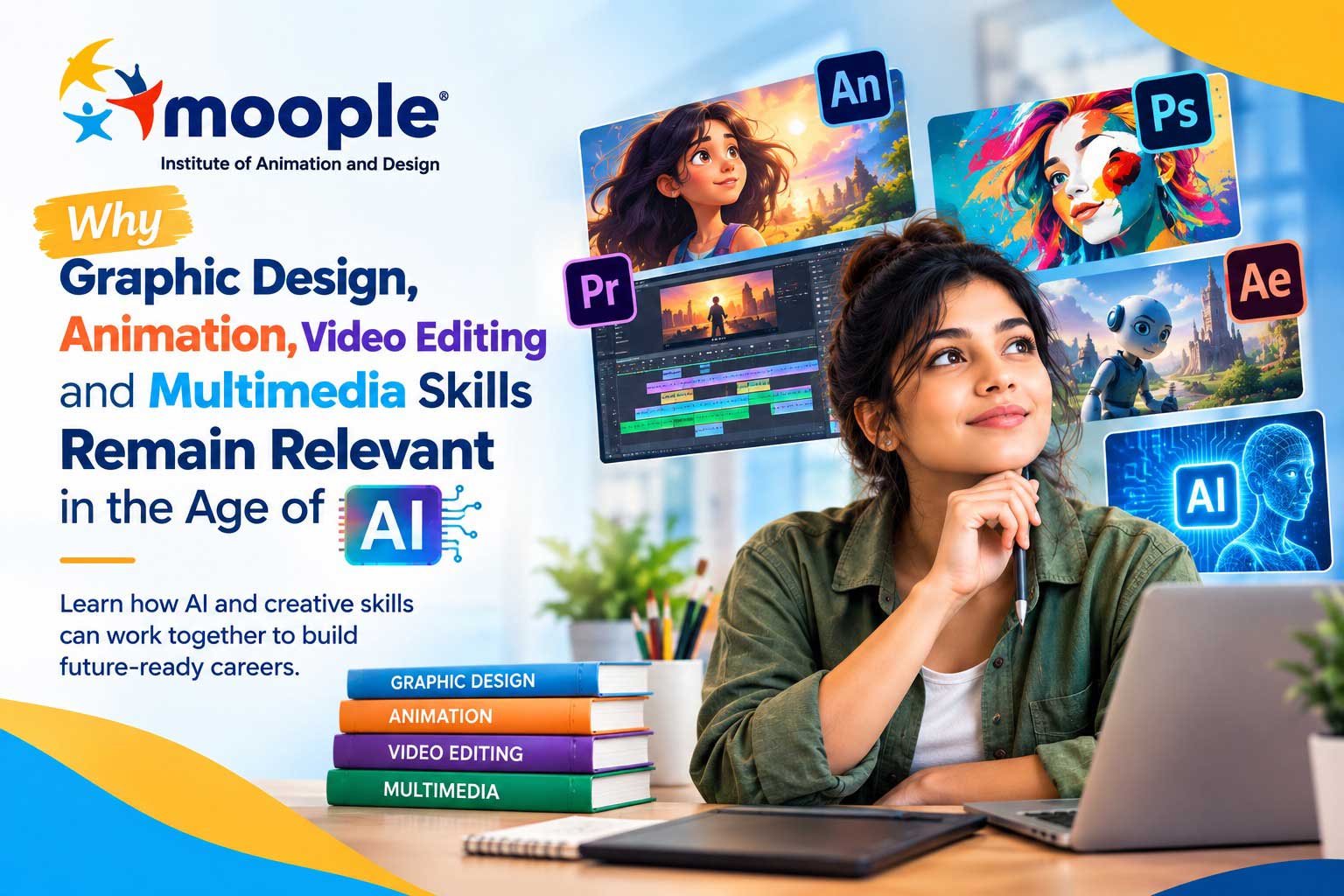
AI vs Multimedia Skills: Why Animation, Graphic Design & Creative Skills Still Matter in the Age of AI
Artificial Intelligence is changing the way we work—and the creative industry is no exception.
From generating images and videos to creating layouts, writing scripts and producing animations, AI tools can now accomplish in seconds what once took hours. Naturally, this has created an important question among students and aspiring designers:
“Will AI replace careers in graphic design, animation, video editing and multimedia?”
The answer is more nuanced than a simple yes or no.
AI is changing how creative work is produced, but it does not eliminate the need for people who understand design, storytelling, visual communication and creative problem-solving.
In fact, as AI becomes more accessible, strong multimedia skills may become even more valuable.
AI Can Generate. But Who Decides What to Create?
AI tools are extremely powerful at generating content based on prompts. But a prompt alone doesn't automatically produce an effective communication piece.
Consider a simple example.
A company wants to launch a new product. AI can generate:
- Multiple logo concepts
- Social media graphics
- Product images
- Video concepts
- Animation ideas
- Advertising copy
But someone still needs to understand:
Who is the audience? What should the brand communicate? What visual style fits the brand? What emotion should the campaign create? Which design actually works?
That requires creative judgment.
A designer who understands composition, typography, colour theory, branding, visual hierarchy and user behaviour can use AI as a powerful assistant rather than seeing it as a replacement.
Graphic Design Is Evolving—Not Disappearing
Graphic design is one of the areas most affected by generative AI.
AI can create impressive visuals quickly, but professional design involves much more than creating an attractive picture.
Graphic designers work with:
- Brand identity
- Typography
- Layout
- Colour systems
- Advertising
- Packaging
- Social media campaigns
- Presentation design
- Digital interfaces
- Marketing communication
AI can provide hundreds of possibilities.
A skilled designer knows which possibility should actually be used.
The future designer therefore isn't simply someone who knows Photoshop or Illustrator.
The future designer is someone who understands design fundamentals + technology + AI tools + communication.
Animation Still Needs Storytelling
AI-generated animation and video technology is developing rapidly. It can help create characters, backgrounds, movements and visual concepts much faster.
But animation is not simply about movement.
It is about:
Story → Character → Emotion → Timing → Visual Language → Audience
A technically impressive animation can still fail if the story doesn't connect with its audience.
Understanding principles such as character design, storyboarding, composition, timing, acting and visual storytelling gives creators the ability to control the creative process.
AI can accelerate production.
The creative vision still needs direction.
Video Editing Is Becoming More Powerful With AI
Modern AI tools can automatically remove backgrounds, generate subtitles, clean audio, identify highlights, create transitions and speed up repetitive editing tasks.
This doesn't make video editors irrelevant.
Instead, it changes the role of the editor.
A future-ready editor can focus less on repetitive tasks and more on:
- Story structure
- Pacing
- Emotional impact
- Visual rhythm
- Sound design
- Audience retention
- Brand storytelling
In other words, AI can help an editor work faster.
But knowing what to edit—and why—is still a human skill.
UI/UX: Where Human Understanding Matters
AI can generate interface designs and prototypes remarkably quickly.
But designing a useful digital experience requires understanding people.
Why does a user abandon a website?
Which button should be more prominent?
How should information be organised?
What makes an interface accessible?
What does a particular audience expect from a digital product?
These questions require research, observation, testing and understanding of human behaviour.
That's why UI/UX professionals who combine design thinking with AI-assisted workflows can create more meaningful digital experiences.
The Real Competition Isn't AI vs Humans
Perhaps the better question is not:
“Will AI replace multimedia professionals?”
The more useful question is:
“Will multimedia professionals who use AI replace those who don't?”
This is where the future of creative careers becomes interesting.
Imagine two designers.
Designer A knows traditional design software but doesn't understand AI tools.
Designer B understands design fundamentals and also knows how to use AI for ideation, image generation, research, variations and workflow automation.
The second designer can potentially explore more ideas, experiment faster and complete certain tasks more efficiently.
The lesson isn't that AI makes creativity unnecessary.
It is that AI literacy is becoming another skill that creative professionals can add to their toolbox.
Skills That AI Cannot Simply Replace
Technology will continue to evolve, but certain foundational abilities remain valuable across creative careers.
1. Creative Thinking
Knowing how to develop an original concept is different from generating multiple variations.
2. Visual Communication
A designer must understand how visual elements communicate a message.
3. Storytelling
Whether it is an advertisement, animation, film, social media campaign or presentation, storytelling remains fundamental.
4. Problem Solving
Clients rarely approach designers saying, “Make something beautiful.”
They usually have a business or communication problem that needs solving.
5. Human Understanding
Understanding culture, emotions, audiences and context cannot be reduced to simply clicking a generate button.
6. Technical Execution
Professional projects still require knowledge of software, workflows, formats, production pipelines and industry standards.
The Future Belongs to Hybrid Creators
The creative professional of tomorrow may not be purely a graphic designer, animator, editor or AI specialist.
Instead, we are likely to see more hybrid creators.
Someone who understands:
Graphic Design + AI
Animation + AI
Video Editing + AI
UI/UX + AI
3D + AI
Digital Marketing + AI
This combination can make creative professionals more adaptable as technology changes.
The important point is that AI should be treated as a tool, not as the entire skill set.
Why Learning the Fundamentals Still Matters
Imagine learning how to use an AI image generator without understanding composition.
You can generate an image—but may not understand why the composition works or doesn't.
Learn AI video generation without understanding editing.
You can generate footage—but may struggle to build a compelling sequence.
Learn AI design tools without understanding typography.
You can produce layouts—but may not know why one communicates better than another.
This is why foundational multimedia education remains important.
Tools change. Principles remain.
Photoshop will evolve.
Illustrator will evolve.
After Effects will evolve.
AI tools will evolve.
New software will appear.
But concepts such as composition, colour, typography, storytelling, visual hierarchy, timing and creative problem-solving will continue to influence how effective visual communication is created.
So, Should Students Learn AI or Multimedia?
They should learn both.
Students shouldn't look at AI and multimedia as two competing career paths.
Instead, think of them as complementary skills.
Start with strong creative and technical fundamentals.
Then learn how AI can enhance those skills.
For example:
Graphic Design → AI-assisted design → Brand communication
Animation → AI-assisted production → Visual storytelling
Video Editing → AI-assisted workflow → Content creation
UI/UX → AI-assisted prototyping → Digital experiences
This approach creates professionals who aren't dependent on one particular software or technology.
They understand the thinking behind the tools.
The Creative Industry Will Keep Changing
Every major technological development has changed creative work.
Digital design changed traditional graphic production.
Digital cameras transformed photography.
Non-linear editing transformed filmmaking.
3D software transformed animation.
Social media transformed advertising and content creation.
Now AI is transforming the workflow again.
The important lesson is that creative professionals have always adapted.
The people who continue learning, experimenting and upgrading their skills can stay relevant as technology changes.
The Future Isn't About Fighting AI. It's About Learning to Use It.
AI is not necessarily the end of multimedia careers.
It is the beginning of a new phase of creative work.
The professionals who understand design + technology + AI + human creativity can approach projects from a much stronger foundation.
Because ultimately, technology can help create an image.
It can generate a video.
It can suggest a layout.
It can automate a workflow.
But someone still needs to understand the audience, the message and the story.
And that is why creative skills remain relevant.
The smartest career strategy isn't choosing between AI and multimedia.
It's learning multimedia skills—and learning how AI can make those skills more powerful.