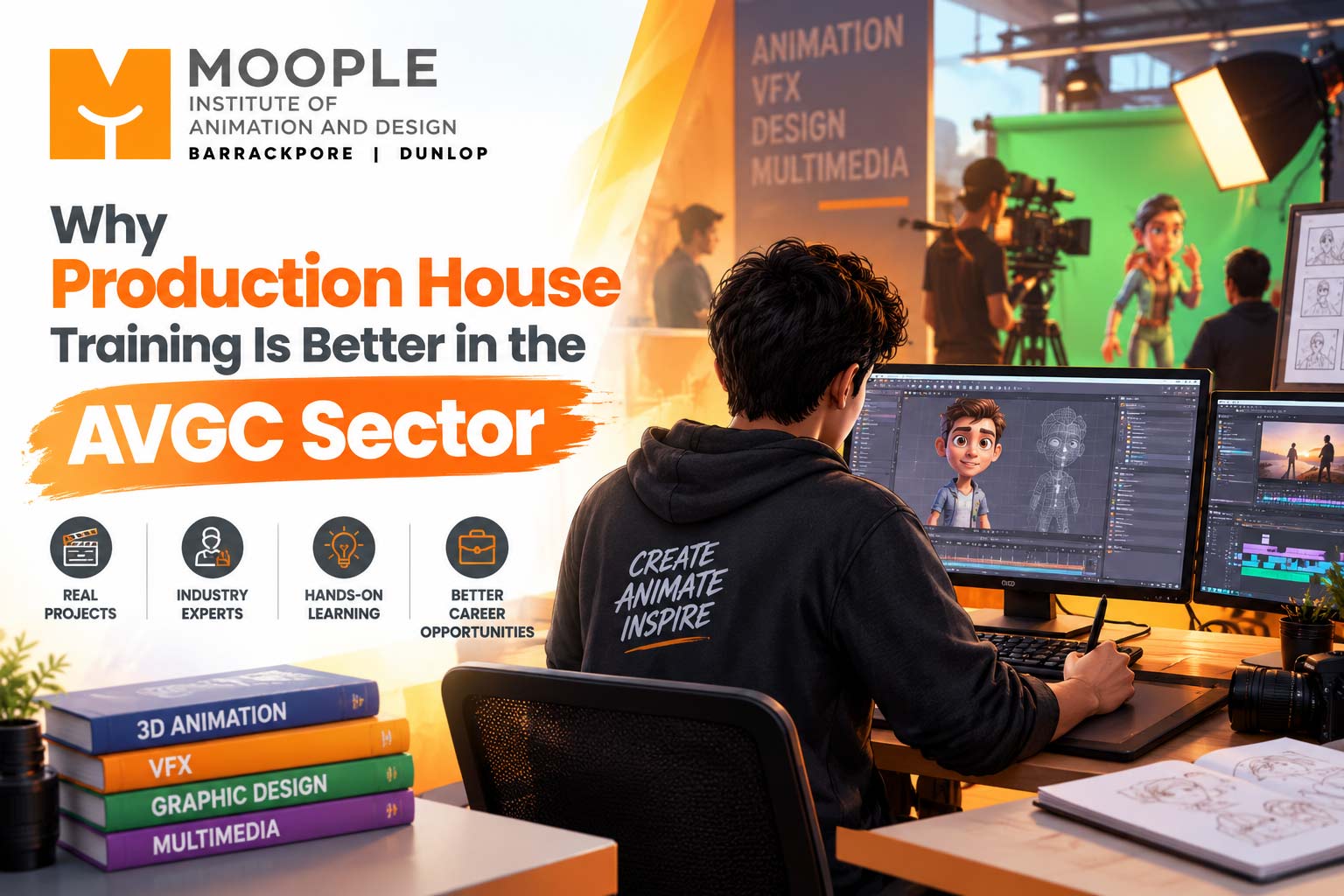
Why a Production-Backed Institute Can Give You a Real-World Edge in Animation, Graphic Design, VFX and Game Design
For students looking to build a career in animation, graphic design, VFX, game design, UI/UX, 3D, motion graphics or digital content, choosing the right institute is about much more than comparing course fees, software lists or certificates.
One important question often gets overlooked:
Does the institute actually understand how creative work is produced in the real industry?
This is where a production-backed institute can offer a significant advantage.
A traditional training institute may teach you software and techniques. A production-backed institute can potentially take that learning a step further by exposing students to real production workflows, professional standards, deadlines, revisions, teamwork and project-based problem solving.
And in today's rapidly changing creative industry, that difference matters.
What Is a Production-Backed Institute?
A production-backed institute is an educational institution that has a connection with, or is supported by, an actual production house, studio or professional creative-production environment.
Instead of learning only inside a classroom, students can be exposed to how creative work moves from an idea to a finished product.
For example, a student learning animation may understand:
Concept → Storyboard → Design → Modelling → Texturing → Animation → Lighting → Rendering → Compositing → Final Output
Similarly, a graphic-design student can understand that professional design isn't simply about making something visually attractive. It involves:
Brief → Research → Concept → Design → Client feedback → Revisions → Final artwork → Delivery
That production mindset can make the learning experience considerably more practical.
Classroom Knowledge vs. Production Experience
Imagine two students applying for the same creative position.
Both know Photoshop, Illustrator, After Effects or 3D software.
But one student has primarily completed classroom exercises.
The other has worked on projects where they had to:
- Follow a creative brief
- Work within deadlines
- Take feedback
- Make revisions
- Maintain professional file structures
- Collaborate with other artists
- Meet quality standards
- Deliver a final production-ready output
The software knowledge may be similar.
The difference is the understanding of how that software is used professionally.
This is one of the biggest potential advantages of production-oriented education.
1. You Learn More Than Just Software
Creative careers are not built simply by knowing software.
Knowing Photoshop doesn't automatically make someone a professional graphic designer.
Knowing Maya, Blender or another 3D package doesn't automatically make someone an animator.
Knowing Unreal Engine or Unity doesn't automatically make someone a game designer.
Software is the tool.
The real value lies in knowing how to use that tool to solve creative and production problems.
A production-backed learning environment can help students understand the difference between:
"I know the software."
and
"I know how to use the software to create professional work."
2. Real Projects Can Build a Stronger Portfolio
For creative careers, a portfolio can be extremely important.
Employers and clients want to see what you can actually create.
A certificate can demonstrate that you completed a course.
A portfolio demonstrates what you can do.
Production-oriented education can therefore be valuable because students may get opportunities to create projects that resemble professional assignments rather than completing only isolated classroom exercises.
A portfolio could include:
- Branding projects
- Social-media campaigns
- Posters and advertising creatives
- Motion graphics
- Character designs
- 2D animation
- 3D modelling
- VFX shots
- Product visualisation
- Game assets
- Game environments
- UI/UX projects
- Short films
- Digital campaigns
The stronger and more relevant the portfolio, the easier it becomes to demonstrate your capabilities to an employer or client.
3. You Understand Industry Workflow
One of the biggest differences between academic learning and professional production is workflow.
In a professional environment, creative work rarely happens in isolation.
A project can involve:
Client → Creative Director → Concept Artist → Designer → Animator → 3D Artist → VFX Artist → Editor → Compositor → Marketing Team
Every person has a responsibility.
Students who experience collaborative production can begin understanding:
- How teams communicate
- How files are handed over
- How feedback works
- Why deadlines matter
- How revisions are managed
- How different departments depend on one another
These are difficult lessons to learn from software tutorials alone.
4. Feedback Becomes Part of Learning
A common misconception among beginners is:
"If my design looks good to me, it is good."
Professional creative work doesn't work that way.
A client, art director, creative director or senior artist may ask you to change something.
Sometimes you may have to completely rethink your approach.
Production exposure can help students become comfortable with one of the most important professional skills:
Taking feedback without taking it personally.
Learning how to interpret feedback, make revisions and improve the final output is a fundamental part of creative production.
5. You Learn to Work Under Deadlines
Creativity and deadlines have to coexist.
A professional designer may not have three days to perfect a poster.
An animator may have to deliver a shot according to a production schedule.
A VFX artist may be working against a fixed post-production deadline.
A game artist may need to deliver assets according to a development pipeline.
Production-based learning can introduce students to this reality early.
It teaches an important professional lesson:
Creative quality matters—but delivery matters too.
6. Industry Exposure Can Help Students Understand Career Roles
"Animation" and "graphic design" are not single careers.
They contain dozens of specialisations.
For example, someone interested in animation could explore:
- 2D Animator
- 3D Animator
- Character Animator
- Motion Graphics Artist
- Storyboard Artist
- Character Designer
- 3D Modeler
- Texture Artist
- Lighting Artist
- Rigging Artist
- Compositor
VFX can include:
- Rotoscopy Artist
- Compositor
- Matchmove Artist
- FX Artist
- Environment Artist
- 3D Generalist
- Previsualisation Artist
Game development can include:
- Game Designer
- Game Artist
- 3D Environment Artist
- Character Artist
- Level Designer
- Game UI Designer
- Technical Artist
- Animator
And graphic design can branch into:
- Brand Designer
- Visual Designer
- Advertising Designer
- Motion Designer
- UI Designer
- Social Media Designer
- Packaging Designer
- Art Director
A production environment can help students understand these roles more clearly and identify where their strengths fit.
7. The Future Is Not Simply "AI vs. Creatives"
Artificial Intelligence is changing creative work—and students should take that seriously.
The World Economic Forum's Future of Jobs Report 2025 identifies AI and big data, technological literacy and other technology skills among the fastest-growing skill areas, while creative thinking, resilience, flexibility and lifelong learning are also expected to increase in importance.
At the same time, the report notes that generative AI is reshaping the labour market and that employers are increasingly focused on upskilling and reskilling.
This means the future creative professional may not be someone who ignores AI.
It may increasingly be someone who understands:
Creative fundamentals + Industry software + AI tools + Human creativity + Production workflow
That combination can be much more valuable than knowing any single tool.
8. India's Creative Industry Is Expanding
The career opportunity isn't limited to traditional animation studios.
The broader creative economy now connects with:
- Films
- OTT platforms
- Advertising
- Gaming
- YouTube
- Social media
- E-learning
- EdTech
- Product visualisation
- Architecture
- Digital marketing
- Virtual production
- AR/VR
- Simulation
- Interactive media
- Mobile games
- Corporate communication
India's Ministry of Information & Broadcasting has highlighted the growth of the Animation, Visual Effects, Gaming and Comics (AVGC) ecosystem and its employment potential. In September 2026, the Ministry said the sector is expected to require nearly 2 million skilled professionals by 2030, while government-backed initiatives such as the Indian Institute of Creative Technologies and AVGC Creator Labs are being developed to strengthen future-ready skills.
Government documents have also identified VFX and gaming as important growth areas within India's AVGC ecosystem, alongside demand generated by digital content, film and television, gaming and international production work.
That doesn't mean every student will automatically get a job.
It means the industry is creating multiple pathways for people with relevant, current skills.
9. The Opportunity Goes Beyond Jobs
One of the biggest advantages of creative skills is that employment isn't the only possible career path.
A skilled professional can potentially work as:
Full-Time Employee
Join an animation studio, advertising agency, gaming company, production house, design agency or corporate creative team.
Freelancer
Work with multiple clients on projects ranging from branding to video editing and motion graphics.
Remote Professional
Creative work can increasingly be delivered digitally, allowing professionals to work with clients and companies beyond their immediate location.
Content Creator
Use design, animation, editing and storytelling skills to build a YouTube channel, social-media brand or independent content business.
Entrepreneur
Start a design studio, animation studio, gaming venture, post-production company or digital creative agency.
This flexibility is one reason creative technology skills can be attractive to students who don't want a single conventional career path.
10. Why Production-Backed Learning Can Matter Even More in the Future
The creative industry is changing quickly.
Software evolves.
AI tools evolve.
Production techniques evolve.
Consumer behaviour evolves.
Platforms evolve.
Therefore, simply memorising a software workflow isn't enough.
Students need to develop the ability to learn, adapt and create.
This is especially important because the World Economic Forum expects a substantial portion of workers' core skills to change by 2030, with technological literacy and creative thinking both playing important roles.
A production-oriented learning environment can help students develop that adaptability because they are exposed to problems rather than just tutorials.
And solving problems is what professional creative work is ultimately about.
What Should Students Look For When Choosing an Institute?
Whether an institute calls itself production-backed or not, students should investigate what the claim actually means.
Before enrolling, ask:
✔ Does the institute have an actual production/studio ecosystem?
✔ Will students work on practical projects?
✔ Who teaches the students—only trainers, or are working professionals involved?
✔ Will students receive feedback and revisions?
✔ Does the course include portfolio development?
✔ Are students exposed to current AI tools and workflows?
✔ Are multiple career paths explained?
✔ Does the institute provide industry interaction?
✔ Are students trained on professional software?
✔ Are there internship, project or production opportunities?
✔ Can you see examples of student work?
✔ What exactly does "placement assistance" or "job support" mean?
These questions are often more useful than simply asking:
"How many software packages are included in the course?"
Production-Backed Education: The Bigger Picture
The real advantage isn't simply having a production house attached to an institute.
The real advantage comes when education and production genuinely interact.
A good learning ecosystem should ideally allow students to move through a journey like:
Learn → Practise → Create → Receive Feedback → Revise → Collaborate → Produce → Build Portfolio → Become Industry-Ready
That is very different from:
Attend Class → Learn Software → Take Exam → Receive Certificate
The certificate may mark the completion of a course.
But the portfolio, practical experience, problem-solving ability and industry understanding can help demonstrate what the student is capable of doing.
Final Thought: Don't Just Learn the Tools. Learn the Industry.
Animation, graphic design, VFX, game design and other creative-technology careers are evolving rapidly.
AI will change workflows.
New software will emerge.
New platforms will appear.
But the fundamentals of creative work—storytelling, design thinking, visual communication, problem solving, creativity and the ability to turn an idea into a finished product—will continue to matter.
That's why students shouldn't choose an institute only because it teaches a particular software package.
They should ask a bigger question:
"Will this institute teach me how the industry actually works?"
A production-backed institute can potentially provide that missing bridge between classroom learning and professional production.
Because ultimately, the goal shouldn't be merely to become someone who knows animation, graphic design, VFX or game-design software.
The goal is to become someone who can use those skills to create work that the industry actually needs.
And in a creative economy increasingly shaped by technology, AI and digital content, that distinction could become more important than ever.