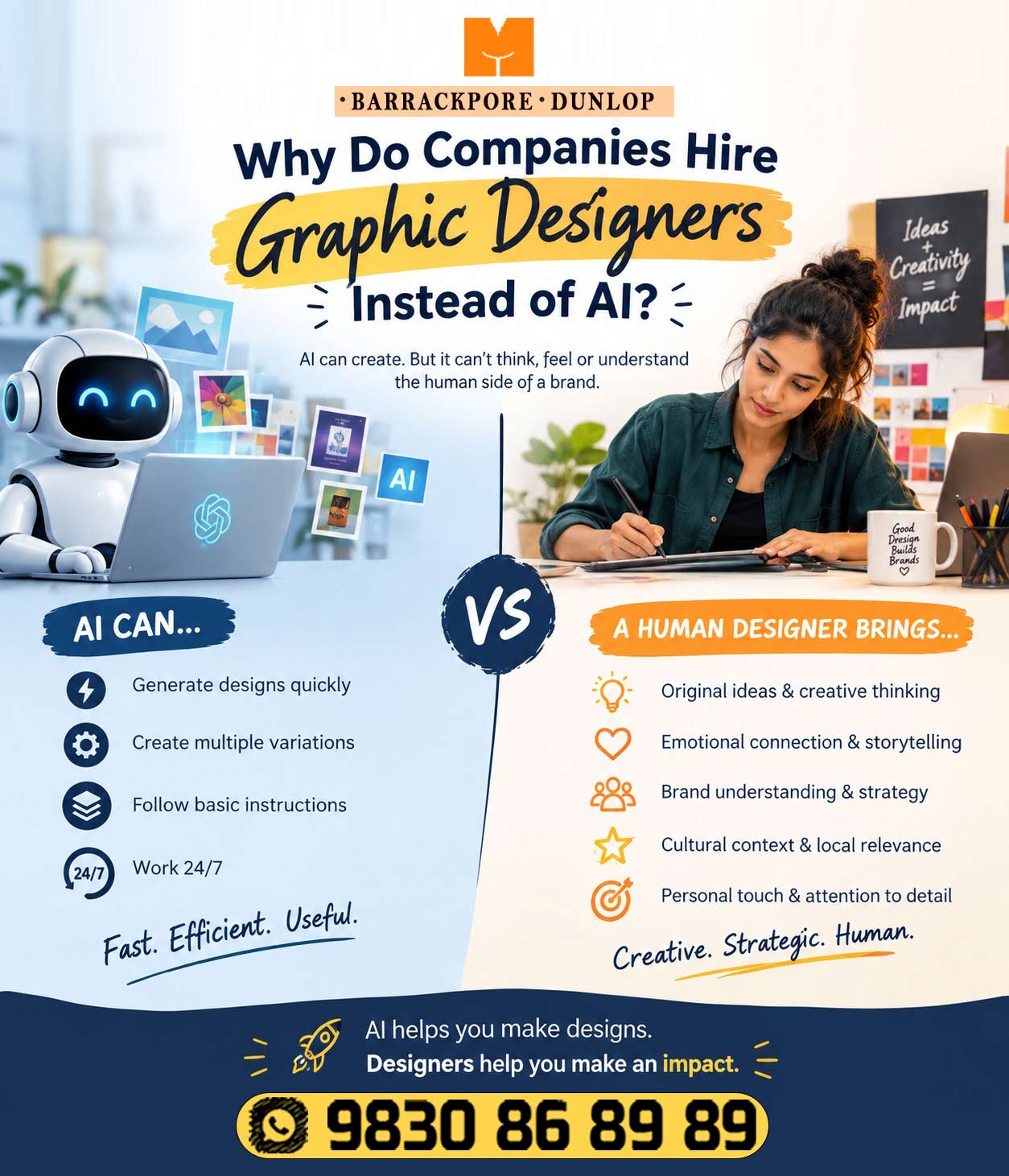
Why Do Companies Hire Certified Graphic Designers Rather Than Relying on AI?
Artificial intelligence (AI) is transforming the creative industry. From generating social media posts to creating logos and marketing visuals, AI-powered tools can produce designs within seconds. However, despite the rapid growth of AI, many companies continue to hire certified graphic designers to handle their branding, advertising, and visual communication needs.
Why does this happen when AI tools are becoming faster, more affordable, and easier to use?
The answer is simple: graphic design is not just about creating attractive visuals. It is about understanding a brand, communicating the right message, solving creative problems, and connecting with an audience.
While AI can support the design process, professional graphic designers bring creativity, strategic thinking, technical knowledge, and human understanding that businesses cannot always obtain from automated tools alone.
Let's explore why companies continue to value certified graphic designers in the age of AI.
1. Human Creativity Goes Beyond AI-Generated Designs
AI tools can generate impressive visuals from text prompts, but generating an image and developing a meaningful design concept are two different things.
A professional graphic designer understands the purpose behind every design element. They consider the target audience, brand personality, emotional response, cultural context, and marketing objective before creating a visual.
For example, a company launching a premium skincare brand may need a visual identity that communicates elegance, trust, and quality. An AI tool can generate attractive packaging concepts, but a designer must evaluate which direction best represents the brand and appeals to its customers.
Certified graphic designers combine imagination, research, experience, and creative judgment to develop original visual solutions.
Why it matters: Companies need designs that communicate a specific message, not just visuals that look good.
2. Certified Graphic Designers Understand Branding and Brand Identity
Brand consistency is essential for businesses that want to build recognition and customer trust. A company's visual identity includes its logo, typography, colour palette, imagery, layouts, and overall design language.
Although AI can generate individual design assets, maintaining a consistent brand identity across multiple platforms often requires careful human supervision.
A certified graphic designer can develop and follow brand guidelines to ensure that every design communicates the same identity, whether it appears on a website, social media page, product package, brochure, or billboard.
For example, a business may require a complete campaign for Facebook, Instagram, Google Ads, and print advertising. Each creative needs a different format, but the brand's identity must remain consistent.
A professional designer understands how to adapt the design without losing its visual character.
Why it matters: Businesses need a recognisable brand identity that works across different marketing channels.
3. AI Cannot Fully Replace Human Understanding and Communication
Every design project begins with a business requirement. Sometimes clients know exactly what they want, but in many cases, they have only a rough idea.
A professional graphic designer asks questions, understands the client's expectations, interprets feedback, and converts abstract ideas into practical design solutions.
For instance, a client might request a promotional poster that feels modern, trustworthy, and suitable for a particular audience. The designer must interpret those preferences, explore creative directions, and refine the final design.
AI can respond to prompts, but the quality of its output depends heavily on the instructions and the human decisions surrounding it.
A certified designer can also explain why a particular colour, layout, font, or visual hierarchy is suitable for the intended audience.
Why it matters: Successful design requires collaboration, interpretation, and thoughtful decision-making.
4. Professional Designers Understand Design Principles
Graphic design involves much more than arranging images and text. It requires knowledge of several essential principles, including:
- Typography: Selecting and arranging fonts for readability and personality.
- Colour theory: Using colours to establish mood, communicate meaning, and strengthen brand recognition.
- Visual hierarchy: Directing the viewer's attention to the most important information.
- Composition: Arranging elements to create balance, clarity, and visual interest.
- Contrast and spacing: Improving readability and making information easier to understand.
- Audience psychology: Adapting visual communication to the needs and expectations of the target audience.
AI-generated designs may follow some of these principles, but the output can still contain inconsistent typography, awkward spacing, unclear messaging, or an ineffective layout.
A trained graphic designer can recognise these problems and correct them with a clear objective in mind.
Why it matters: Businesses need designs that are visually appealing, functional, readable, and aligned with their communication goals.
5. Certified Designers Can Adapt Designs to Specific Business Requirements
Every business has different goals, audiences, budgets, and brand guidelines. A design that works for a fashion brand may not work for a financial services company.
Professional designers understand that creative decisions must reflect the client's industry, positioning, and marketing objectives.
They can develop designs for a wide range of applications, including:
- Logo and brand identity design
- Social media creatives and advertising banners
- Website graphics and landing page visuals
- Product packaging and label design
- Brochures, catalogues, and company profiles
- Outdoor advertising and promotional materials
- Infographics and presentation designs
- E-commerce product visuals
AI can assist with generating concepts and exploring different visual directions. However, a professional designer evaluates the options, refines the details, and ensures that the final output meets the actual requirements.
Why it matters: Businesses need tailored design solutions rather than generic visuals.
6. Technical Skills Matter in Professional Graphic Design
A design may look excellent on a computer screen but still fail when it is printed, resized, uploaded, or transferred to another production workflow.
Professional graphic designers understand the technical requirements of different design formats and applications.
For example, a designer preparing a print advertisement must consider resolution, colour modes, bleed, margins, and file formats. A designer creating website graphics must consider dimensions, file size, responsiveness, and visual clarity.
Industry-standard software such as Adobe Photoshop, Adobe Illustrator, and other design applications gives trained professionals greater control over editing, precision, and production workflows.
AI-generated assets may also require substantial editing, formatting, and quality checks before they are ready for commercial use.
Why it matters: Companies need production-ready files that meet the technical requirements of their projects.
7. Quality Control and Attention to Detail
A small design error can affect a company's credibility. Incorrect text, inconsistent brand colours, poor alignment, distorted elements, or unsuitable imagery can make a campaign look unprofessional.
Professional graphic designers review their work carefully before delivering the final files. They check layout consistency, typography, image quality, alignment, brand compliance, and other project-specific requirements.
AI-generated visuals can sometimes contain incorrect text, unusual details, inconsistent objects, or elements that do not match the original brief. Human review is therefore important, especially when designs contain product details, promotional offers, logos, or factual information.
Certified designers can identify and correct such problems as part of a structured design workflow.
Why it matters: Consistent quality helps protect brand reputation and reduces avoidable production mistakes.
8. Copyright, Licensing, and Responsible Use of AI
Businesses must consider the legal and commercial implications of the visuals they use. Questions about image licensing, ownership, originality, trademarks, and the use of third-party assets can affect how a design is created and distributed.
AI-generated content introduces additional considerations. The applicable rules can depend on the tool, its terms of service, the source material, and the jurisdiction.
Professional graphic designers can help companies use properly licensed assets, follow brand guidelines, document creative decisions, and identify potential risks. However, certification alone does not guarantee copyright compliance, and AI use is not automatically unlawful.
Companies should review the relevant software terms, obtain appropriate permissions, and seek legal advice when a project raises significant intellectual-property concerns.
Why it matters: Responsible design practices help businesses reduce risk and make informed decisions about commercial creative assets.
9. Strategic Design Can Support Marketing Performance
Graphic design is an important part of marketing communication. The right visual can help a business attract attention, explain an offer, communicate value, and encourage customers to take action.
A professional designer considers the purpose of each creative before deciding how it should look.
For example, a social media advertisement promoting a graphic design course may need to highlight the course benefits, key software skills, training opportunities, and a clear call to action. A designer must organise these elements so that the message is easy to understand and visually engaging.
AI can generate alternative concepts quickly, but human judgment is still needed to assess the relevance of those concepts, ensure factual accuracy, and align the creative with the campaign strategy.
Of course, design alone does not guarantee sales or conversions. Performance also depends on the offer, audience targeting, budget, placement, and other marketing factors.
Why it matters: Companies need design that supports business objectives, not simply attractive artwork.
10. Certification Demonstrates Structured Training and Professional Knowledge
Why do companies specifically look for certified graphic designers?
A recognised graphic design certification can provide evidence that a candidate has completed structured training or demonstrated particular skills. Depending on the programme, it may cover design fundamentals, software proficiency, typography, colour theory, layout, branding, and practical projects.
Certification can help employers evaluate candidates, particularly when they have limited professional experience. A portfolio, however, remains essential because it demonstrates how effectively a designer applies those skills to real creative challenges.
Employers generally consider a combination of factors, such as:
- Relevant graphic design certification or formal training
- A strong portfolio of original work
- Proficiency in industry-standard design software
- Creative thinking and problem-solving skills
- Communication and teamwork
- Attention to detail and ability to meet deadlines
- Understanding of branding and marketing requirements
It is important to remember that certification alone does not guarantee employment or professional excellence. Its value depends on the quality and relevance of the training, the candidate's practical abilities, and the employer's requirements.
Why it matters: Certification combined with practical skills gives employers a clearer picture of a candidate's preparation for professional design work.
11. AI and Human Designers Can Work Together
The debate is not simply about whether AI or human designers are better. In many professional environments, the most effective approach is to combine the strengths of both.
AI tools can help designers brainstorm ideas, explore colour combinations, generate rough concepts, remove backgrounds, and speed up certain repetitive tasks.
Human designers can then evaluate those outputs, correct errors, develop original concepts, maintain brand consistency, and prepare the final deliverables.
Consider a typical workflow for a marketing campaign:
- The designer studies the brief and target audience.
- AI tools may help explore initial concepts or visual references.
- The designer selects an appropriate creative direction.
- The design is refined using professional software.
- Typography, branding, content, and technical details are checked.
- The final assets are adapted for the required platforms and reviewed before delivery.
This approach can improve efficiency without removing the need for creative judgment and quality control.
Why it matters: Designers who learn to use AI responsibly alongside their core design skills can become more adaptable in a changing industry.
12. Why Businesses Should Invest in Skilled Graphic Designers
Hiring a professional graphic designer is not merely an additional expense. It is an investment in effective visual communication.
A capable designer can help businesses establish a consistent identity, improve the presentation of their products and services, create engaging marketing materials, and maintain quality across campaigns.
However, businesses should evaluate designers based on their actual capabilities, portfolio, experience, and suitability for the project rather than relying on certification alone.
Similarly, AI should not be dismissed. It can be valuable for rapid ideation, experimentation, and selected production tasks. The key is to understand when automation is appropriate and when a project requires greater human involvement.
For high-visibility branding, complex campaigns, specialised design requirements, and work involving sensitive or important brand information, experienced human oversight can be particularly valuable.
Conclusion: The Future Belongs to Skilled Designers Who Adapt
AI is changing the graphic design industry, but it has not eliminated the need for professional designers. Companies still need people who can understand business goals, develop creative concepts, maintain brand consistency, communicate with clients, solve design problems, and deliver high-quality work.
Certified graphic designers bring structured knowledge and practical training to the creative process. When supported by a strong portfolio, relevant experience, and the ability to use modern tools, these skills can make them valuable contributors to a company's marketing and branding efforts.
The future of graphic design is likely to involve greater collaboration between human creativity and artificial intelligence.
For aspiring designers, the best approach is to build a strong foundation in design principles, practise with professional software, develop a compelling portfolio, and learn how to use AI as a creative assistant rather than relying on it for every decision.
AI can help generate a design, but skilled designers bring the understanding, judgment, and purpose that turn a visual into effective communication.
Frequently Asked Questions (FAQs)
1. Why do companies hire certified graphic designers instead of relying only on AI?
Companies hire certified graphic designers for their design knowledge, creative judgment, branding expertise, communication skills, and ability to refine work according to specific business requirements. Certification can demonstrate structured training, while a portfolio helps prove practical ability.
2. Can AI completely replace graphic designers?
AI can automate or accelerate certain design tasks, but it does not eliminate the need for human oversight, strategic thinking, client communication, and quality control. The extent of automation depends on the task and the complexity of the project.
3. Is a graphic design certification important for getting a job?
Certification can help demonstrate relevant training, especially for entry-level candidates. However, employers may also prioritise portfolio quality, software skills, practical experience, creativity, and communication.
4. Which software should aspiring graphic designers learn?
Adobe Photoshop and Adobe Illustrator are useful starting points for image editing, illustration, branding, and marketing graphics. Other tools may be relevant depending on the role, including layout software and AI-assisted creative applications.
5. Will learning AI tools benefit graphic designers?
Yes. AI tools can help with ideation, visual exploration, and selected repetitive tasks. Designers who combine these tools with strong fundamentals and critical judgment can adapt more effectively to evolving creative workflows.
6. What skills do companies look for in a professional graphic designer?
Employers commonly look for visual communication skills, typography, colour theory, layout, branding, software proficiency, problem-solving, attention to detail, collaboration, and a strong portfolio of relevant work.