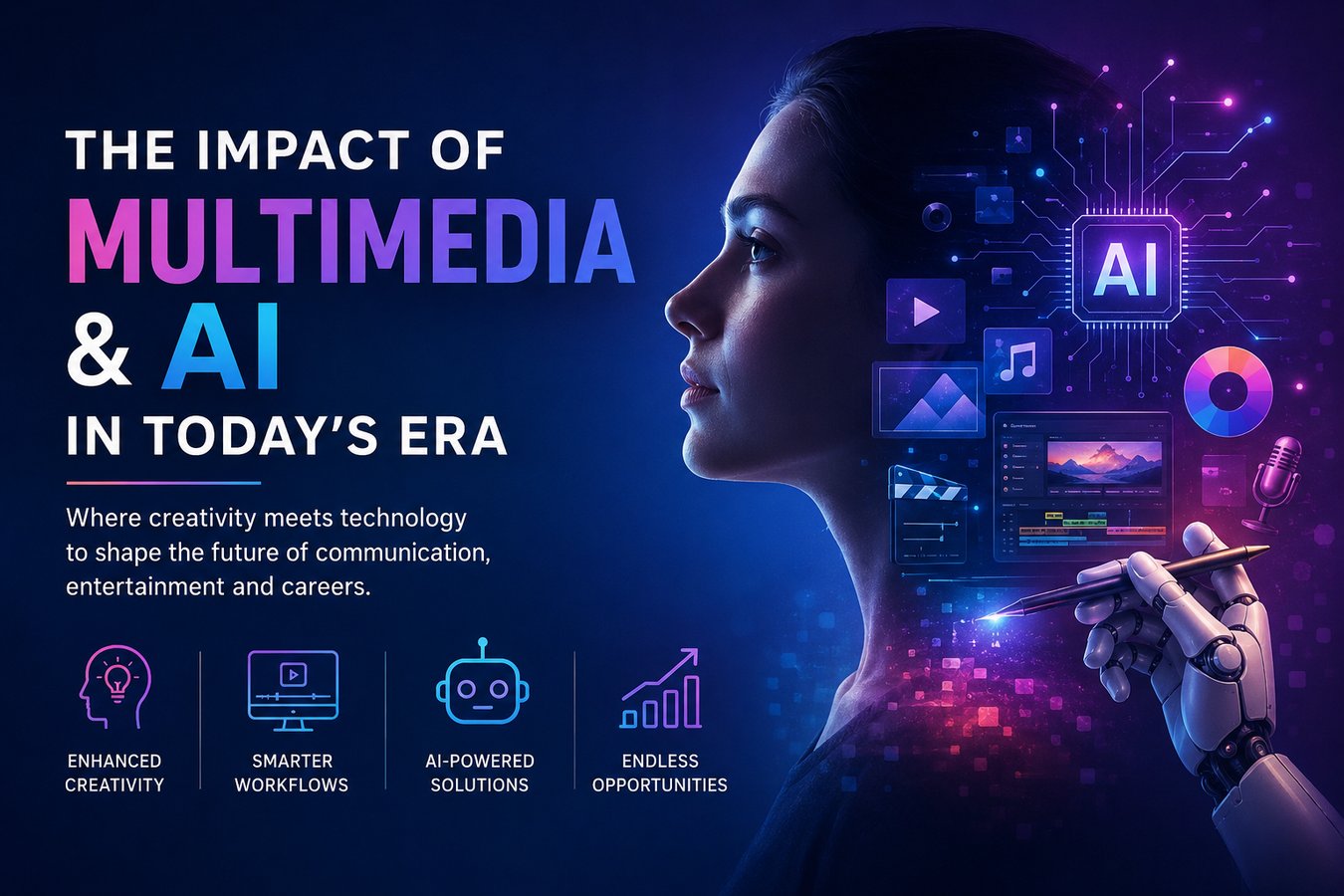
The Impact of Multimedia and AI in Today’s Era: Where Creativity Meets Technology
There was a time when creating a video meant having an expensive camera, editing equipment, a team of professionals, and sometimes even a studio. Designing a poster required specialised software and years of practice. Creating animation could take weeks or months.
Today, things are changing rapidly.
With multimedia and Artificial Intelligence (AI) becoming part of our everyday lives, the way we create, communicate, learn, work, and even build careers is undergoing a major transformation.
But this is not simply a story about technology replacing people. It is a story about people learning to work with technology.
Multimedia Is Everywhere Around Us
Think about a normal day.
You wake up and check Instagram. You watch a YouTube video while having breakfast. You see an animated advertisement while travelling. You attend an online class, browse a website, play a game, or watch a movie in the evening.
Almost everything you consume digitally involves multimedia.
Graphics, animation, photography, video, sound, motion graphics, UI/UX and visual effects have become essential ways of communicating ideas.
Businesses have realised that people don't just want information anymore—they want experiences.
A simple advertisement can tell you what a product does. But a well-designed video can make you feel why you need it.
That is the real power of multimedia.
And Then Came AI
Artificial Intelligence has added another layer to this creative world.
Today, AI can help generate images, write scripts, create voiceovers, remove backgrounds, analyse audiences, generate ideas, assist with video editing, create 3D assets and automate repetitive design tasks.
For a creative professional, this can feel both exciting and slightly intimidating.
The question naturally arises:
“If AI can do so much, will it replace designers, animators, editors and other creative professionals?”
The honest answer is more complicated than a simple yes or no.
AI Can Create. But Humans Still Decide What Matters.
AI can generate an image in seconds.
But it doesn't automatically know whether that image communicates the right emotion to a particular audience.
AI can suggest a script.
But a human understands the cultural context, the brand personality and the emotion behind the story.
AI can assist with editing.
But deciding which moment should stay, which moment should disappear and what the audience should feel still requires creative judgement.
This is why the future is unlikely to belong to people who simply compete against AI.
It will belong to people who know how to use AI effectively.
The Creative Professional Is Becoming More Powerful
Imagine a graphic designer who previously spent three hours removing backgrounds, resizing assets and making repetitive variations.
With AI-assisted tools, much of that work can be completed far more quickly.
The designer can then spend more time thinking about:
- Concept
- Composition
- Branding
- Storytelling
- Visual communication
- Audience psychology
- Creative direction
In other words, AI can take care of some of the repetitive work, allowing humans to focus more on the meaningful work.
That's a powerful combination.
Multimedia + AI = A New Career Landscape
The job market is changing too.
Companies today don't necessarily want someone who knows only one software.
They increasingly value people who can combine multiple skills.
For example, a modern creative professional might know:
Photoshop + AI tools + Motion Graphics + Video Editing + Social Media + Branding
An animator might combine:
3D Animation + Unreal Engine + AI-assisted workflows + Storytelling
A UI/UX designer might work with:
UX Research + UI Design + Prototyping + AI + Design Systems
The boundaries between traditional job roles are becoming less rigid.
This creates new opportunities for people who are willing to keep learning.
But There Is a Catch
Learning AI alone is not enough.
Knowing how to type a prompt into an AI tool does not automatically make someone a designer, animator or filmmaker.
Technology can generate possibilities.
Skill determines which possibility is actually good.
A person who understands design principles will generally get more value from AI design tools than someone who has never learned composition, colour, typography or visual hierarchy.
Similarly, someone who understands filmmaking will know how to use AI video tools more effectively than someone who simply generates random clips.
The strongest combination is therefore:
Human creativity + professional skills + AI literacy.
Creativity Is Becoming More Important, Not Less
This may sound surprising, but as AI-generated content becomes easier to produce, genuinely creative ideas may become more valuable.
If everyone can generate an attractive image in seconds, simply creating an attractive image won't be enough.
The question becomes:
What makes your idea different?
That is where human creativity matters.
Your experiences, emotions, cultural understanding, observations and imagination are things that cannot simply be reduced to a button.
AI can help you execute an idea.
But the idea worth executing still matters.
What Should Students Learn Today?
For students considering a career in multimedia, animation, design, VFX, gaming, filmmaking or digital media, the message is simple:
Don't run away from AI. Learn it.
But don't abandon the fundamentals either.
Build strong foundations in:
- Graphic Design
- Animation
- Video Editing
- Motion Graphics
- 3D
- VFX
- UI/UX
- Storytelling
- Visual Communication
Then learn how AI can improve those skills.
Most importantly, build a portfolio.
A certificate can show that you completed a course.
A strong portfolio can show what you can actually create.
The Future Won't Be Human vs AI
Perhaps the biggest misconception about the future of creative careers is that it will be humans versus machines.
A more realistic picture is:
Humans + AI vs Humans without AI.
The person who understands creativity, has professional skills and knows how to use AI will have a significant advantage over someone who refuses to adapt.
Technology has always changed creative industries.
Photography didn't kill painting.
Digital cameras didn't kill photography.
Video editing software didn't kill filmmaking.
And AI doesn't necessarily have to kill creativity.
Instead, it may change what creativity looks like.
The Real Question Is: Are We Ready to Adapt?
The world of work is moving quickly.
The skills that were enough five or ten years ago may not be enough forever.
But that doesn't mean we should be afraid of change.
It means we should become better at learning.
For students, professionals and creative individuals, this is actually an exciting time. The tools available today can turn ideas into reality faster than ever before.
Someone with a laptop, creativity and the right skills can create content, build a portfolio, work with clients, launch a brand or even build a career from anywhere.
The technology is becoming more accessible.
The human imagination is still the differentiator.
Final Thought
AI may change the tools we use.
Multimedia may change the way we communicate.
But one thing remains constant—the need for people who can think, create, understand emotions and tell meaningful stories.
The future doesn't belong to those who fear AI.
And it doesn't belong to those who blindly depend on it either.
It belongs to those who learn how to combine technology with their own creativity.
Because the most powerful creative tool of the future may not be AI alone.
It may be a human who knows how to use AI.